
Aluminium Metal Baffle Ceilings: The Benefits In Modern Architecture
Views: 0 Author: Site Editor Publish Time: 2026-06-12 Origin: Site


Modern commercial architecture demands striking open-plan aesthetics. Designers want airy, expansive environments to impress visitors and inspire occupants. However, achieving this architectural vision without compromising building performance remains a critical challenge. We constantly see a clash between visual intent and daily operational reality.
Traditional continuous ceilings restrict HVAC efficiency and complicate routine MEP (Mechanical, Electrical, Plumbing) maintenance. On the flip side, leaving structural roof decks completely exposed often causes severe acoustic issues. Raw ceilings also create visual clutter from sprawling overhead utilities. You end up trading one problem for another.
Integrating an Aluminum Baffle Ceiling bridges this gap between open-plenum design and functional performance. It provides a scalable, code-compliant, and architecturally striking solution tailored for high-traffic commercial environments. In this guide, you will learn how these linear metal systems optimize airflow, mitigate noise, and streamline mechanical integration.
Key Takeaways
Acoustic & Environmental Control: Baffle systems disrupt sound waves and, when paired with acoustic infills, significantly improve Noise Reduction Coefficient (NRC) ratings in open spaces.
Seamless MEP Integration: The open linear design masks overhead ductwork and wiring while allowing unrestricted airflow and immediate maintenance access.
Compliance & Durability: Aluminum is non-combustible, lightweight, and corrosion-resistant, satisfying strict commercial fire codes and reducing structural load.
Specification Realities: Successful deployment requires precise evaluation of metal gauge, carrier system compatibility, and site-specific deflection limits.
The Business Case: Resolving Open-Plenum Challenges
The architectural shift toward exposed ceiling decks dominates modern commercial design. Tech companies, retail brands, and corporate offices love the industrial, spacious feel. Yet, stripping away acoustic tiles creates unintended consequences. Spaces quickly become noisy echo chambers. Voices carry across vast open floors, severely reducing acoustic privacy. Furthermore, raw ceilings expose chaotic utility layouts. Exposed pipes, electrical cable trays, and thick ductwork disrupt the intended visual harmony.
Unlike continuous drop ceilings, linear systems optimize environmental control. Closed drywall or tile ceilings often trap stale air. They also require expensive, extensive register networks. In contrast, baffles facilitate natural thermal mass cooling. The open gaps let air flow freely. Warm air rises naturally past the metal panels, while cooled air descends evenly into the occupied zone. This continuous exchange ensures uniform air distribution across massive floorplates, significantly boosting overall HVAC efficiency.
Facility managers despise continuous rigid ceilings. Routine maintenance often requires destructive access or cumbersome panel removal. Baffle gaps offer direct, unimpeded access to critical overhead services. Maintenance crews can easily reach fire sprinklers, lighting drivers, and complex HVAC components. They can inspect, repair, or upgrade utilities without tearing down the ceiling. This intelligent design drastically reduces the time needed for facility management tasks and minimizes operational disruptions.
Core Functional Benefits of an Aluminum Baffle Ceiling
Commercial fire codes dictate strict safety parameters. Public egress zones like airport terminals, shopping malls, and hospital corridors demand entirely non-combustible materials. An Aluminum Baffle Ceiling inherently carries an A-class fire rating. Unlike real wood or cheap plastics, structural aluminum will not ignite, melt rapidly, or spread flames. This intrinsic safety feature simplifies strict code compliance for architects, builders, and safety inspectors.
Sound bounces aggressively off hard, flat concrete decks. Vertical panels interrupt these sound waves efficiently. Their vertical orientation drastically increases the available sound absorption surface area. For high-reverberation areas, you should specify perforated metal profiles. You can then insert specialized acoustic fleece inside these perforated channels. This combination catches ambient noise, breaks the sound energy, and sharply boosts the space's overall Noise Reduction Coefficient (NRC).
Dead load concerns heavily influence structural engineering decisions. Aluminum weighs significantly less than steel or solid timber panels. This lightweight profile minimizes the physical burden placed on a building's primary structure. Because the extrusions are exceptionally light, engineers can design wider structural spans. Installers need far fewer suspension points. This reduction speeds up the hanging process, limits material usage, and lowers the strain on the roof deck.
Design Flexibility and Finish Capabilities
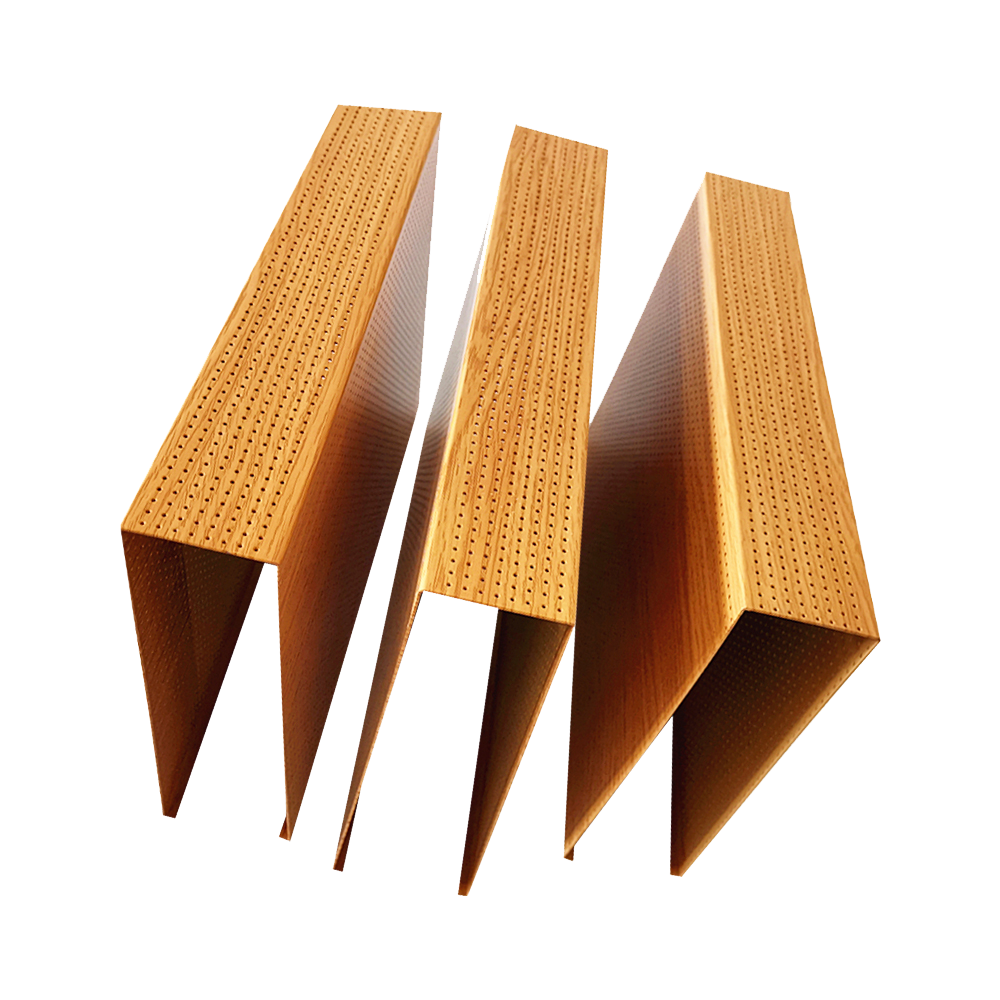
Real wood ceilings offer incredible aesthetic warmth. However, they bring severe fire risks, heavy weight, and continuous moisture-warping issues. Wood-look sublimation perfectly solves this dilemma. Manufacturers apply high-definition timber grain patterns directly onto the metal surface using heat transfer films. You achieve the visual warmth of real oak, walnut, or pine without suffering the structural or safety drawbacks of natural timber.
Ceiling elements do more than just hang overhead. You can use them strategically to shape the user experience. Deploy linear, curved, or varying-depth baffles to create distinct visual pathways. These dynamic lines subtly guide foot traffic. They work exceptionally well as intuitive wayfinding tools. Passengers in sprawling transit hubs or shoppers in complex retail environments naturally follow the ceiling's directional flow.
Modern ceilings must integrate illumination flawlessly. You can specify precise interior channel dimensions during manufacturing. This customization allows you to flush-mount LED linear fixtures directly inside the extrusions. The lights seamlessly disappear into the ceiling plane. Aluminum also acts as an excellent natural heat sink, extending the lifespan of your LED drivers. This seamless integration eliminates visual clutter and creates a sleek, highly cohesive architectural statement.
Key Evaluation Criteria for Specifying Baffle Systems
Not all metal ceilings perform equally under stress. Specifying the correct material gauge is absolutely critical. We strongly recommend a thickness between 0.6mm and 1.0mm+ depending on the span. Thinner materials risk visible bowing or edge deflection, especially over lengths exceeding three meters. High-grade metal alloys maintain their structural rigidity over decades, ensuring the ceiling remains perfectly straight.
You must carefully evaluate different suspension methods. U-profile tracks offer standard, reliable support for interior spaces. Custom clip-in systems provide tighter alignment for complex, multi-level designs. If you specify an Aluminum Baffle Ceiling for semi-exterior applications like entrance canopies, engineers must conduct rigorous wind-load calculations. Wind uplift can easily dislodge improperly secured carriers, creating severe safety hazards.
Match your surface coating specification strictly to the local environment. Standard architectural powder coating works exceptionally well for climate-controlled interiors. However, high-performance PVDF finishes offer vastly superior protection. They resist chalking, fading, and corrosion in high-humidity or high-UV environments.
Green building certifications matter deeply in modern construction. Aluminum is infinitely recyclable without losing its mechanical properties. Always verify the recycled content percentage before finalizing your purchase orders. High recycled content and documented end-of-life recyclability directly support LEED points and broader corporate sustainability goals.
To help simplify the specification process, review this quick comparison chart of common finish options:
Finish Type | Best Environment | Durability Characteristics | Aesthetic Outcome |
|---|---|---|---|
Standard Powder Coat | Controlled Interiors | High scratch resistance, easy to clean. | Solid colors, matte or gloss, highly uniform. |
PVDF Coating | Exteriors & High Humidity | Extreme UV resistance, prevents chalking. | Vibrant solid colors, maintains gloss over decades. |
Wood-Look Sublimation | Lobbies, Retail, Hospitality | Resists moisture warping unlike real wood. | High-definition timber grain, warm visual texture. |
Implementation Realities and Installation Risks
Installing complex linear systems requires meticulous pre-planning. You must conduct thorough pre-installation MEP coordination using BIM (Building Information Modeling) if available. Map the planned carrier track runs against all existing overhead piping, cable trays, and ductwork. This early digital mapping prevents expensive clashes during actual installation. Finding a clash while crews are on scaffolding wastes immense time and resources.
Site handling poses another major risk factor. Aluminum looks pristine straight out of the box. However, it is highly prone to scratching and edge denting if crews mishandle it. Busy, chaotic construction sites present constant hazards. Planning for secure, clean staging areas is essential. Keep the panels wrapped in protective film and elevated off the floor until the moment they are ready for hanging.
The most glaring installation mistake is creating "wandering lines." Even a millimeter of drift looks terrible over a fifty-foot corridor. Achieving perfectly parallel installations demands absolute precision from the framing crew. We advise following these mandatory alignment steps:
Establish Laser Baselines: Project laser grids across the entire ceiling plenum before hanging any wire.
Secure Suspension Wires: Anchor the suspension wires tightly to the true structural deck, ensuring zero slack.
Level Carrier Tracks: Lock the main U-profile or clip-in carriers into place, checking the horizontal level continuously.
Clip and Space Panels: Snap the aluminum extrusions into the carrier clips, double-checking the gaps with standardized spacer blocks.
Conclusion
Aluminum baffle ceilings are much more than mere decorative elements. They serve as highly engineered solutions for managing acoustics, concealing utilities, and ensuring fire safety in modern commercial structures. By replacing heavy, combustible materials with lightweight metal extrusions, you solve numerous open-plenum design challenges simultaneously.
Moving forward, designers and contractors must adopt a rigorous shortlisting logic. You should always request physical mockups to verify scale and finish quality in actual lighting conditions. Demand certified acoustic test reports, specifically NRC data, if noise mitigation is a primary project goal. Finally, consult directly with manufacturers regarding custom carrier integrations before finalizing your architectural specifications. Proper planning guarantees a flawless, high-performing ceiling installation.
FAQ
Q: What is the cost difference between an aluminum baffle ceiling and real timber baffles?
A: Real timber baffles demand expensive structural supports, fire-retardant treatments, and frequent maintenance. Aluminum eliminates these secondary expenses. It is lighter, requiring fewer suspension points, and arrives pre-finished with a permanent Class-A fire rating. Over the building's lifecycle, aluminum presents significant structural and operational savings that offset initial material costs.
Q: How do you clean and maintain aluminum baffle ceilings?
A: Aluminum systems require very low maintenance. Most panels feature static-resistant finishes like premium powder coats or PVDF, which naturally repel dust. Facility teams only need simple dusting protocols. A long-handled microfiber duster or low-pressure vacuum attachment used semi-annually keeps the extrusions pristine without requiring harsh chemical cleaners.
Q: Can aluminum baffles be installed in curved or vaulted ceilings?
A: Yes, they accommodate complex geometries easily. Manufacturers utilize flexible carrier tracks that bend to match a building's specific radius. The aluminum extrusions themselves can also be custom-rolled during fabrication. This adaptability allows designers to create sweeping, vaulted ceilings or undulating wave patterns conforming perfectly to the architectural shell.
Q: How does a metal baffle ceiling impact fire sprinkler distribution?
A: Open-plenum layouts highly benefit fire suppression systems. Because the ceiling features substantial gaps between panels, the open percentage typically satisfies local fire marshal requirements. Smoke flows up, and sprinkler water sprays down unimpeded. This eliminates the need to drop individual sprinkler heads through ceiling tiles, streamlining MEP installation.


